

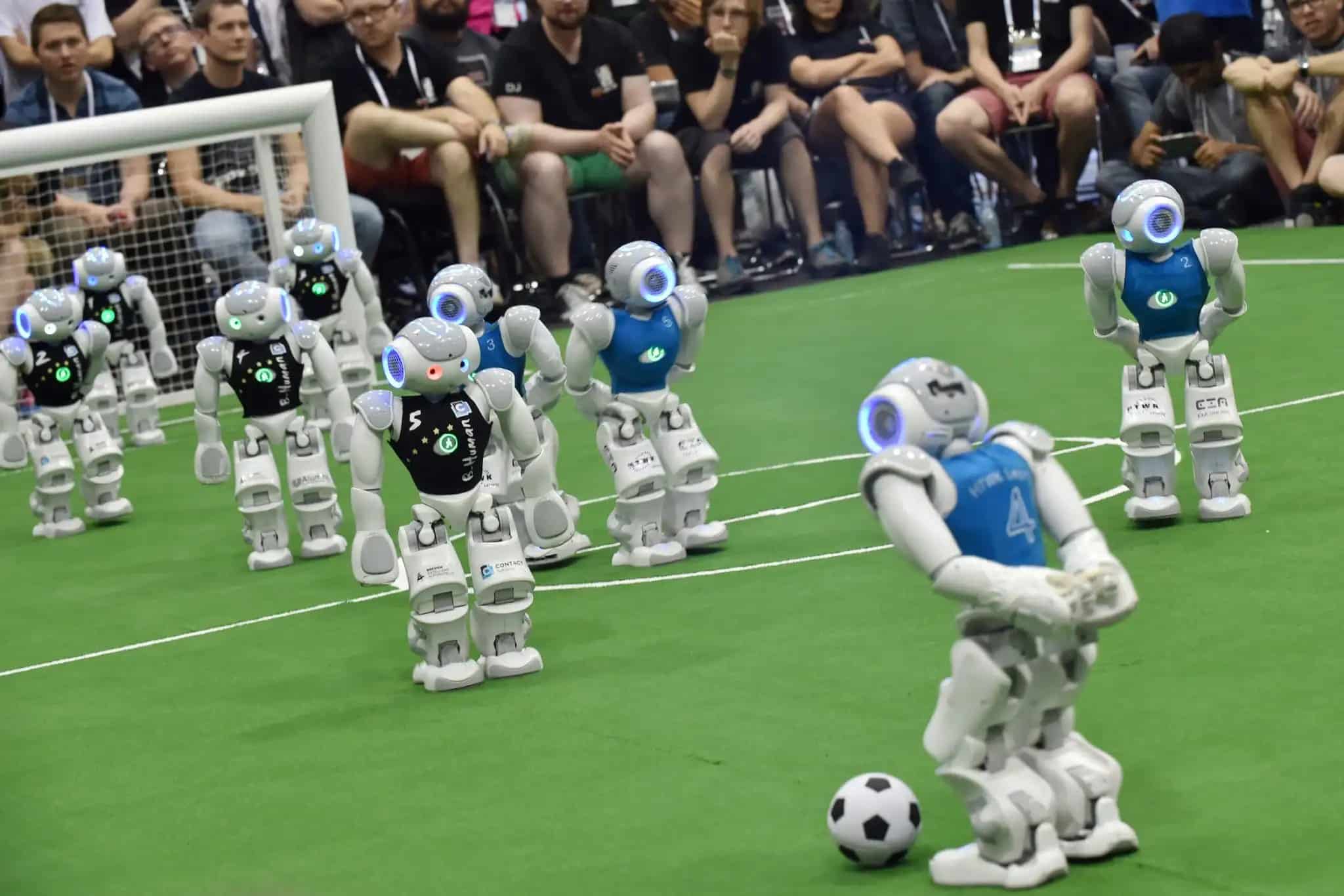
The ROBO League tournament, a turning point in China, took place in Beijing. This tournament witnessed a full-fledged football competition in the 3v3 format of autonomous robot teams for the first time in China. In the final match, the THU Robotics team from Tsinghua University defeated the Mountain Sea team from China Agricultural University with a score of 5:3, demonstrating the impressive progress in the field of robotics.
This competition was an important milestone in preparation for the World Robot Games to be held in 2025, revealing both the achievements and current limitations of the technology. Despite frequent collisions and difficulties avoiding obstacles, organizers had to adapt the rules and allow ’unintentional“ contact between machines. The biggest breakthrough was the full autonomy of the robots: they moved independently at speeds of up to 1 meter per hour, maintained their balance, and even got up from where they fell without outside intervention.
The Ultimate in Robot Football
Cheng Hao, founder of Booster Robotics, stated that the current level of play of robots is comparable to that of five-year-old children, but technology is improving exponentially. The organizers announced plans to create a series of similar competitions that should accelerate advanced developments in real application areas, from industry to services. This match was not only a technical demonstration, but also an important step towards the integration of humanoid robots into daily life.
The Future of Robot Football
Robot football appears as a concrete example of the advances in artificial intelligence and robotic technologies. Such events provide a platform for engineers and scientists to develop more capable and autonomous robots. In the future, robot football matches will not only be a means of entertainment, but will also promote the use of robots in different sectors by showcasing their ability to perform complex tasks.
Challenges Facing Robots
Robot football matches also reveal some of the challenges faced by robots. For example, robots keeping their balance, avoiding obstacles, and interacting with other robots are quite complex tasks. To overcome these challenges, sensor technologies, artificial intelligence algorithms and motion control systems of robots are constantly being developed.
Application Areas of Robot Football
The successes achieved in robot football contribute to the development of technologies that can be used in different sectors. These technologies enable the design and production of robots that can be used in areas such as industrial automation, logistics, healthcare and search and rescue. For example:
- Industrial Automation: Precision motion control systems used in robotic football can help develop robots that perform tasks such as assembly, packaging and quality control in factories.
- Logistics: Autonomous navigation and obstacle avoidance technologies contribute to the development of robots that optimize the transportation of goods in warehouses and distribution centers .
- Health Services: Sensor technologies used in robotic football may enable the development of robots that assist surgeons in surgeries and improve rehabilitation processes.
- Search and Rescue: Durable and autonomous robots can help save human lives by using them in search and rescue operations in disasters such as earthquakes and floods.
As a result, the historical robot football match in China is not only an indicator of the progress in robotic technologies, but also sheds light on the future application areas of these technologies. Robot football will continue to provide a platform for engineers and scientists to develop more capable and autonomous robots.


